Invariant Hyperbolic Unfolding: anchoring hyperbolic radius so one graph encoder transfers to unseen graphs
Why a hyperbolic graph encoder trained on one graph misreads hierarchy on another, and how fixing radius from a structural percentile inside each graph — while learning only the angle — lets one frozen encoder, trained only on synthetic graphs, predict links on graphs it has never seen.
Most graph models are trained and used on the same graph. Deploying one model across graphs that share no nodes — a new marketplace, a new citation network, a new social platform — without retraining remains hard. This paper studies a strict version of that problem for link prediction: the model may look at the target graph's observed topology, because that is the input it has to work on, but it gets no target labels, no example links, no fine-tuning, no text attributes and no post-hoc alignment. "Zero-shot" here means no target supervision or adaptation, not inference without the graph.
Hyperbolic graph neural networks are a natural candidate. Hyperbolic space grows exponentially with radius, so trees and hub-and-spoke structures embed with little distortion, and the popularity–similarity view of networks gives the coordinates a meaning: radius says how central a node is, angle says whom it resembles. The trouble is that standard hyperbolic encoders learn both coordinates freely, and nothing calibrates radius across graphs. The same structural role ends up at different radii in different graphs, and a frozen distance-based decoder has no way to know which scale it is looking at. I call this radial non-identifiability, and it is a transfer barrier specific to the hyperbolic setting.
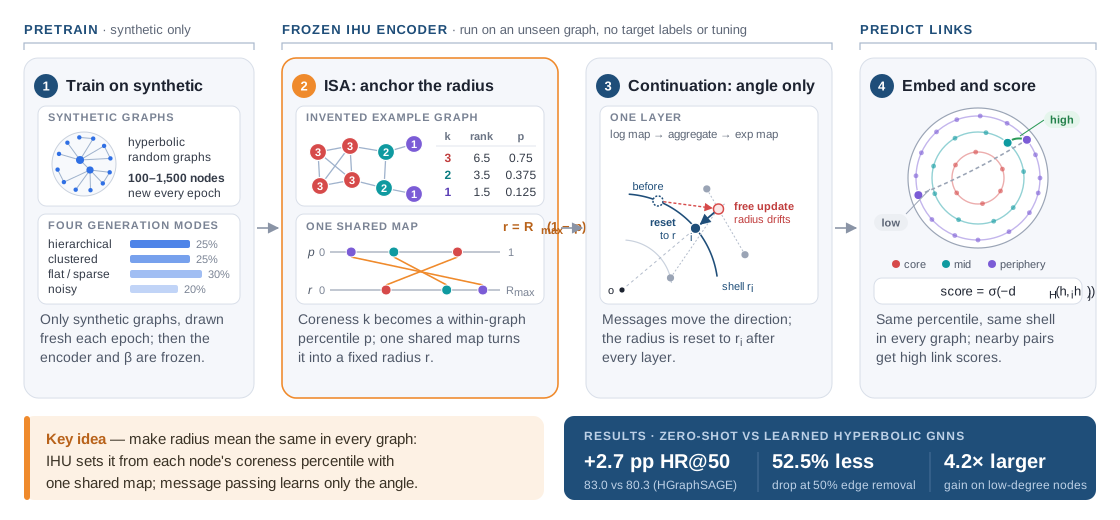
The method, Invariant Hyperbolic Unfolding (IHU), removes the barrier by canonicalizing radius instead of learning it. In matched comparisons of frozen learned encoders across five real graphs it improves average HR@50 by 2.7 percentage points over the strongest learned hyperbolic baseline and by 7.7 points over the hyperbolic family mean, and the gain grows when local evidence is scarce: 52.5% less degradation when half the edges are removed and a 4.2× larger advantage on the lowest-degree nodes. This post explains the setting, the barrier, the two operations that make up IHU, how it was trained and tested, and where fixed shells stop helping.
Transfer with nothing but the target's topology
Recent graph foundation models and universal link predictors are often described as zero-shot, but they sit in different access tiers. UniLP and TFMLinker condition on labelled positive and negative links from the target graph; OFA, ZeroG, OpenGraph, GraphAny and H4G mainly address classification or rely on text, features or target task semantics; ULTRA targets multi-relational knowledge graphs. Labelled target links reveal how the target graph forms links, and a post-hoc alignment step can fit a target-specific correction. IHU deliberately gives up both.
| Family | Target topology | Target labels or demos | Role in the paper |
|---|---|---|---|
| IHU | yes | no | the method studied |
| Frozen GNNs and hyperbolic GNNs | yes | no | primary learned baselines |
| Common neighbours, Adamic–Adar, Katz, PPR | yes | no | transductive references |
| UniLP, TFMLinker | yes | yes | stronger target access |
| Graph foundation and KG models | mixed | mixed | adjacent settings |
The question is therefore mechanism-level and sharp: within matched frozen backbones and identical target access, what changes when hyperbolic radius is learned freely versus constructed from structure?
Why a learned radius does not transfer
In the Lorentz model a point can be written in polar form around the origin: a radius, which is its hyperbolic distance from the origin, and a unit direction. Under the popularity–similarity hypothesis from hyperbolic random-graph theory, small radius corresponds to popularity and hierarchy, and angular proximity to similarity. That suggests treating radius as a global structural coordinate and angle as a local relational one.
Standard hyperbolic GNNs learn the two jointly, and that is where transfer breaks. The effective radius of a hyperbolic random graph grows with the logarithm of its size, so an absolute radius means different structural roles in graphs of different size. If two graphs place the same percentile of hubs or peripheral nodes at different radial scales, a frozen decoder cannot know which scale to trust at test time. The failure is geometric: the learned coordinate system itself is not shared.
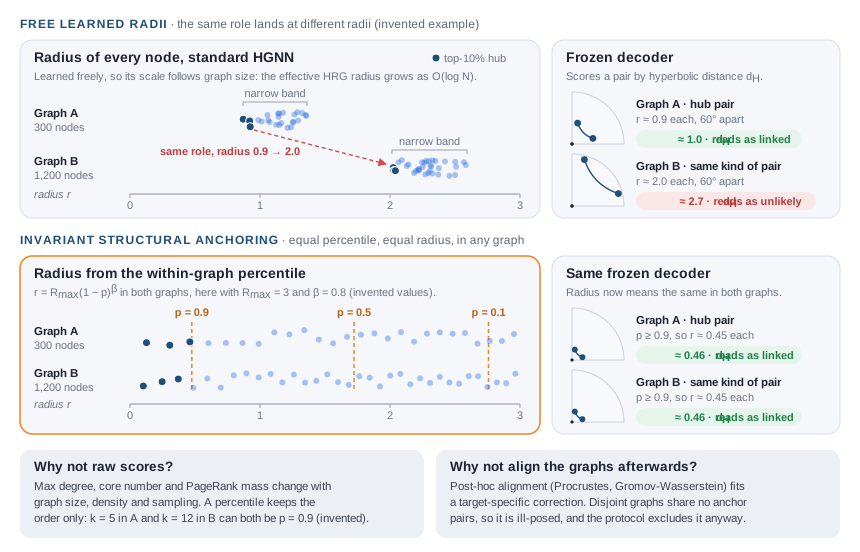
The obvious repairs do not hold up. Raw structural values are not portable: maximum degree, core number and PageRank mass all change with graph size, density and sampling. Post-hoc alignment such as Procrustes or Gromov–Wasserstein matching is ill-posed without anchors, and numerical limits near the hyperbolic boundary compress the usable radial range further, so learned radii often collapse into a narrow band.
Invariant Structural Anchoring: percentile first, then one shared map
IHU's answer is selective invariance: fix the coordinate that cannot be identified across graphs, and keep learning the one that can. The first operation, Invariant Structural Anchoring (ISA), sets every node's radius before any message passing.
It starts from a permutation-invariant structural score that reflects prominence. The default is coreness from k-core decomposition — the largest k for which the node survives repeatedly peeling away nodes of degree below k — because it is a canonical descriptor of core–periphery structure; degree and PageRank are evaluated as alternatives. Each score becomes a mid-rank percentile inside its own graph, so ties share their average rank and arbitrary tie-breaking cannot invent radial distinctions. Percentiles keep the within-graph hierarchy and discard exactly the nuisance scales that make raw values non-portable.
One monotone map then turns the percentile into a radius: r = R_max (1 − p)^β, clamped to a minimum radius to avoid the origin. High-score nodes go near the origin and low-score nodes outward. R_max sets the hyperbolic capacity, and β is learned during synthetic pretraining and then frozen. The map is not meant to recover an absolute radius of some generative model. It defines a reusable coordinate system: the target graph supplies the radial ordering, and the two frozen parameters decide how much hyperbolic capacity that ordering gets.
Continuation: let learning move only the angle
Fixing the starting radius is not enough, because standard hyperbolic message passing — map neighbours to the tangent space, aggregate, map back — lets radius drift with every layer. The second operation, Continuation, is a radial retraction applied after each layer: keep the direction of the updated point, and reset its radius to the ISA anchor. If the update is too small to define a direction, the previous one is kept.
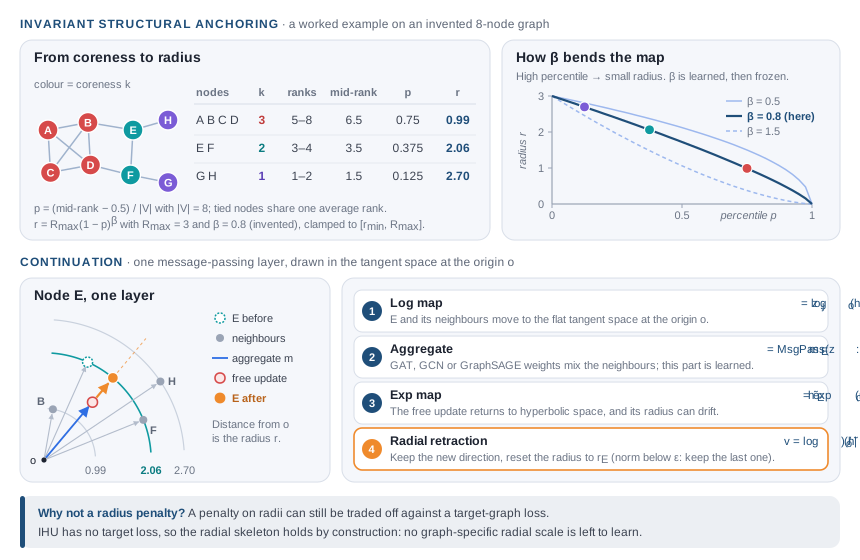
This is stronger than a penalty on radius. A regulariser can always be traded off against a loss on the target graph; IHU has no target loss at all, so it enforces the radial skeleton by construction and leaves the optimizer no graph-specific radial scale to discover. Learning acts on angle, and angle is where local similarity lives. The backbone can be GAT, GCN or GraphSAGE — IHU fixes only the radial channel — embeddings are 32-dimensional Lorentz vectors, links are scored by σ(−d_H) between the two endpoints, and training combines binary cross-entropy with a sampled softmax.
Why anchoring is principled, in brief
Under the hyperbolic popularity–similarity model, expected degree decreases with latent radius. The appendix formalizes three consequences. Degree ranks recover radial ranks within the identifiable hierarchical core, using variance-sensitive Bernstein-type bounds because the sparse regime makes standard bounds vacuous. Equal structural percentiles in independently sampled graphs correspond to equal latent radial quantiles under shared model parameters, so coordinates are aligned in advance instead of by fitting a correction afterwards. And encoders with fixed radii form a strict subclass of unconstrained hyperbolic encoders, so their Rademacher complexity is no larger.
These statements are idealized, and the paper says so: it does not claim coreness recovers latent radii on every real graph. Its claim is narrower — if a score is a monotone proxy for prominence, rank-canonicalization removes exactly the radial degree of freedom that cannot be identified across graphs. Whether that inductive bias survives real graphs is an empirical question.
Trained on synthetic graphs, tested on real ones
Every learned model in the comparison is trained only on synthetic hyperbolic random graphs, generated fresh every epoch from four modes — hierarchical, clustered, flat and sparse, and noisy — with 100 to 1,500 nodes and a temperature curriculum that starts with sharp edge boundaries and gradually softens them. Real graphs are never used for training, validation, early stopping or hyperparameter selection.
The frozen encoders are then evaluated on Amazon Computers and Photo, Coauthor CS and Physics, and WikiCS — up to 34,493 nodes, more than twenty times the largest training graph. Each real graph is split into observed input edges (85%) and held-out positives (15%); message passing and every structural score are computed from observed edges only. HR@50 ranks each held-out link against 200 sampled corruptions, and results average five split seeds without target-based run selection.
Results
Across the five graphs, IHU-GAT reached the best average HR@50 and IHU-SAGE the best average AUC:
| Frozen encoder | Average AUC | Average HR@50 |
|---|---|---|
| GCN (best Euclidean) | 68.6 | 38.2 |
| HGCN | 81.2 | 70.5 |
| HGAT | 85.6 | 75.3 |
| HGraphSAGE (strongest learned hyperbolic) | 88.5 | 80.3 |
| IHU-GCN | 87.3 | 80.9 |
| IHU-SAGE | 89.1 | 82.6 |
| IHU-GAT | 88.9 | 83.0 |
IHU-GAT leads HR@50 on four of the five datasets; WikiCS is the exception (83.7 for HGraphSAGE against 82.1). The embeddings show the intended effect: coreness shells with 100% monotonicity, 3.2 times higher radial discrimination and 3.4 times wider radial interquartile range than HGAT, whose radii concentrate in a narrow range.
The advantage grows exactly where local evidence is scarce, and the analysis also finds its limit:
| Stress | Easy | Hard | What happens |
|---|---|---|---|
| Edges removed at inference | 0% | 50% | 52.5% less degradation (5.16 vs 10.86 points); HR@50 77.0 vs 64.6 |
| Lower endpoint degree | top quintile | bottom quintile | gain grows from +2.7 to +11.3 points, 4.2× |
| Coreness gap between endpoints | same shell | four shells apart | gain falls from +8.5 to −0.7 points |
The sparsification result holds across backbones (51.7–53.4% less degradation), which points to the stable percentiles rather than to one architecture. Low-degree nodes are the node-level version of the same story: both reduce local evidence but not necessarily global structural rank. The last row is the boundary condition: fixed shells can over-separate legitimate links between the core and the far periphery.
Changing only the anchoring score shows that the node-to-radius assignment matters, not just radial spread: average HR@50 is 83.0 with coreness, 75.3 with degree and 66.8 with PageRank, and drops to 61.9 when coreness radii are shuffled across nodes and 62.2 with random percentiles. IHU helps when the structural score is informative, and can hurt when the imposed radial order is wrong.
Try it
The live model below lets you watch the coordinate system itself. It generates two graphs from the same hyperbolic random-graph family — a small graph A and a larger, denser graph B — and places their nodes by radius and angle. Start with percentile anchoring and note how the two curves of radius against percentile lie on top of each other; switch to a raw-score radius whose scale was fitted on graph A and watch B's nodes land on different radii. Then remove edges from B, add message-passing layers, and turn Continuation off to see the radial channel drift and flatten.
Live model. Two hyperbolic random graphs are generated in your browser with the generator the paper uses for pretraining. Coreness, degree or PageRank becomes mid-rank percentiles and ISA radii, or a raw-score radius whose scale is fitted on graph A, and a parameter-free tangent-space message-passing step runs with or without Continuation. Nothing is trained and no link-prediction score is computed — angles start at the generator's hidden angles and β is a slider. The results above are the paper's, on real graphs. Open the live model on its own page ↗
Two things the demo shows are worth reading carefully. On these synthetic graphs, degree and PageRank agree with the generator's hidden radius more closely than coreness does — the theory is stated for degree — yet on the five real graphs coreness was the most effective anchor. And with PageRank, which is already normalized for graph size, a raw scale moves less than the percentile when edges are removed. Percentiles make whichever proxy you choose comparable across graphs; choosing a proxy that tracks prominence in the graphs you care about is still your job.
What I learned
Decide which coordinates should be learned. The gain did not come from a larger model or more data. It came from refusing to learn a coordinate that cannot be identified across graphs and constructing it from structure instead.
A constraint beats a penalty when there is no target loss. Without supervision on the target, a regulariser has nothing to trade against; enforcing the radial skeleton by construction leaves the optimizer no graph-specific scale to rediscover.
Look for the gain where local evidence is thin. On easy edges the methods are close. The fixed hierarchy channel matters most under missing edges and for low-degree nodes — the cases that look like cold start in recommendation, new authors in citation graphs or new users on a platform.
Report the boundary, not just the average. The coreness-gap analysis shows where fixed shells hurt, and that is what tells a practitioner when the simple design is reliable and when an adaptive variant is worth building.
Limitations
- IHU fits graphs where topological prominence is a useful hierarchy proxy; near-regular, weakly hierarchical or strongly semantics-driven graphs may need interpolation between anchored and learnable radii.
- Percentiles can be noisy in small graphs or tied under discrete scores such as coreness, and very large or streaming graphs need approximate core decomposition and incremental percentiles.
- The comparison isolates radial canonicalization among frozen learned encoders; a full comparison with classical transductive heuristics would need a separate, access-matched benchmark with harder negative sampling.
Results are from the paper, which uses public benchmark graphs only. The live model generates synthetic graphs in the browser and illustrates the anchoring mechanism; it trains no encoder and reproduces none of the reported numbers.